Hyper-concave

Description

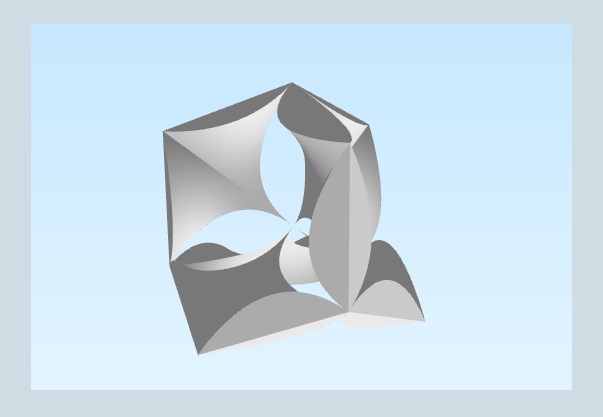
An axially self-intersecting minimal surface cluster made up of three centrally connected opposite pairs outspread on cusp forming parabolic arc frames.
The idea

The base pattern was imagined as an “inverted hyperbolic paraboloid” where instead of fluidly merging into the horizontal plane, every perpendicular cross section passing through the center osculates towards the vertical axis.

To understand this perspective, think of the hypar as a continuous transition between a convex and a concave parabolic arc, gradually loosing its curvature towards the middle where completely flattens into a line. Contrary to this scenario, the two ends of our shape are diametrically opposed perpendicular cusps which both are gradually transforming into the vertical axis.
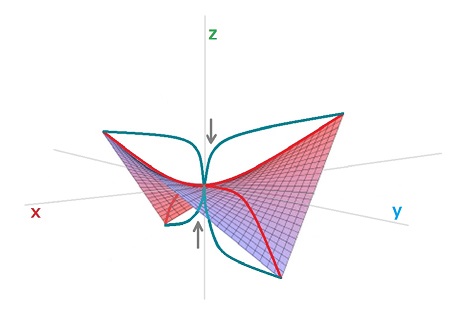
The relation between the principal curvatures of the hyperbolic paraboloid (red) and of the Hyper-concave (teal)

Construction

1. The frame

First I built six centrally interconnected cusps, each coplanar with one of a regular tetrahedron’s edges, with their two endpoints situated on the tetrahedral vertices. As such, the curvatures will start from the line of the tetrahedral edges and will end tangential to the three main axes. This setting is analogous but reversed with the one made by the principal curvatures of three axially intersecting hyperbolic paraboloids where are also three pairs of diametrically opposed perpendicular elements.
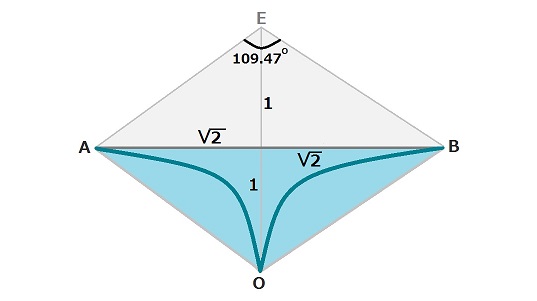
One cusp shaped generatrix pair (teal) coplanar with an edge (AB) of the reference tetrahedron, pointing towards its center (O). Triangle AOB is the inner half of the AEBO rhomb, part of the rhombic dodecahedral scheleton

Now we reached the trickier part. While in case of the hypar the gradual transformation of the convex parabolic arc into the concave one happens along the tetrahedral edges by doing a complete revolution with the generatrix (half arc) following a skew rectangle frame made up by 4 connected edges, in case of our shape the definition of the exact revolution path is less obvious as the vertical axis into which the transformation must be directed is coplanar with the generatrix itself (half cusp).

The first thing I concluded is that the path must be a curved segment which first will leave the plane of the cusp from the generatrix then return to this at the axis. Second conclusion was that the projection of the end vector must form a 45 degree angle with the cusp plane, as 90 degree will be covered adding it’s complementary half related to the diametrically opposite perpendicular cusp, then returning to the initial one and repeating the mirroring action another 3 times to complete a full 360 degree revolution. The tetrahedral vertices are given, but exactly where on the axes will be those “return points”?
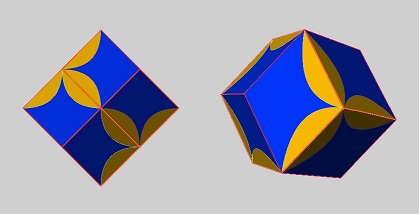
Two different views of the complete Bézier curve pattern on the surface of a reference rhombic dodecahedron with one cusp on each face

The breakthrough came when I realized that the most coherent way to achieve this is when the path in question has the exact same shape as the half cusp generatrix itself, consequently everything will happen inside a regular rhombic dodecahedral lattice where two neighboring such paths will be coplanar, forming identical cusps with the original ones. This way the distance from the center of the path convergence points situated on the 3 main axes represents the small diagonals of the rhombic faces while the reference tetrahedron’s edges are the big diagonals.

2. The surface creation

The elements of the formerly described frame can be sorted into two sets of identical Bézier curves: 24 outer ones which are coplanar in pairs with the rhombic dodecahedron’s faces and 12 inner ones which are likewise coplanar with the 6 internal rhombs of the same solid. These together with the 3 main axes will divide the structure into 24 triangular segments each made up by 2 neighboring (outer and inner) curves and a half axis. The minimal surfaces formed on these will be the faces of the Hyper-concave.
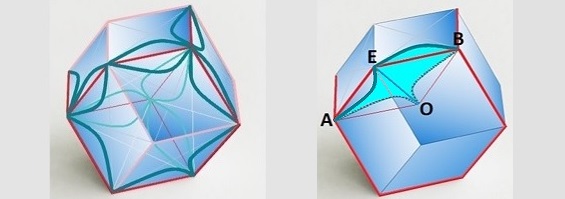
The external and internal arcs on the rhombic dodecahedron (left) respectively one minimal surface highlighted in cyan color (right)

While this was the exact course of action I built it, actually there are not 24, but only 12 minimal surfaces as the axes are representing the intersections between 2 double-sized minimal surfaces bordered by a common inner cusp and two different but diagonally connected outer curve pairs (right side of the above image). The composition has 11 principal points of which 10 are vertices (6 double, 4 triple) and one is the center.

The peculiar characteristic of this shape is that none of the cross sections passing through the center has any convex sectors, thus outside the axial intersections is exclusively concave, hence its name “hyper-concave”. While this can be stated also about other simpler shapes like the interior of a sphere or about any ellipsoid for that matter, those are forming closed systems, lacking the external perspective. A hemispheric bowl’s inner surface is both fully concave and externally observable but is missing a complete spatial span. Regarding the hyperboloid, the concave continuity is valid only along the axis of revolution, while the perpendicular cross section is fully convex, having a circle profile.

The other hallmark of the construction is the visual coherence achieved by the contour overlap of multiple symmetrical segments with complementary nature, when there are perspectives which highlight the tight fitting of triple, respectively quadruple clusters of almond shaped constituents as their projections are the same. As such, the material mass bordered by the convex (concentric) outer curves are exactly filling the similarly shaped gaps between the concave (radial) inner ones.
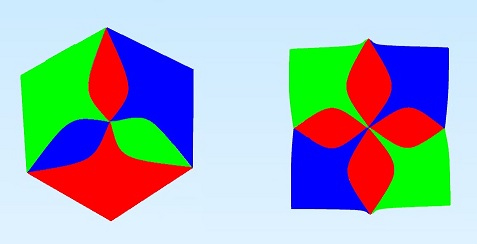
Two principal perspectives showing the spatial disposition of the three “inverted hypars”

After identifying this unique characteristic I realized that in case of the quadruple overlap both the convex and concave edges are projections of cusp pairs made by 90 degree parabolic segments drawn on three perpendicularly intersecting central squares, where the original arcs are becoming distorted by the tilted setting of the rhombic faces.

While conceptually akin, this fitting property is nonexistent in case of the tetrahedral divergence, as despite the superficial resemblance that composition has a quite different structural arrangement, presenting significant gaps from all perspectives, also there the inner arcs are not identical with the outer ones.
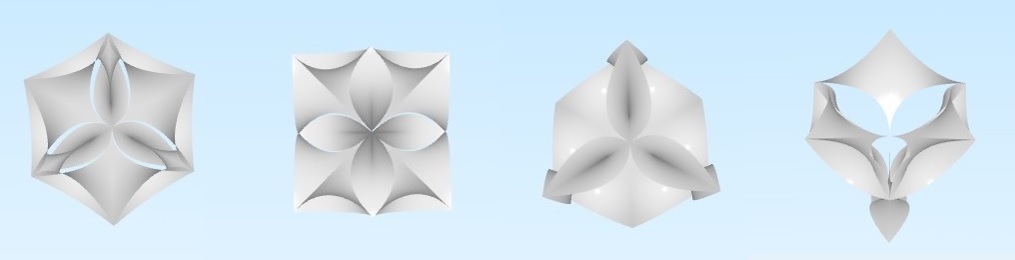
The four characteristic view of the solid

Regarding the formerly mentioned quadruple pattern, if we do a perspective comparison with the composition made by three intersecting hyperbolic paraboloids we can observe that beside the common square frame there the visibility of the one seen from above is halved as the concave part will be masked by the convex sectors of the other two hypars with oblique view, while in case of the concave radiance there’s no masking, but perfect boundary overlap between the three. Here the cross made by the almond shaped parts represents the perpendicular view, while the remaining sectors are diagonally distributed between the neighboring oblique ones.

Relatedness with 2D shapes

The planar equivalent of the Hyper-concave is a certain pattern inside the rhombille tiling which needs three colors for the best representation. Because the concave edge triplets of the radial gaps enclose the exact same space between them as the outer convex boundaries will with the identical ones sitting on the neighboring cells (tessellation) two opposite colors (white and black) have to be chosen to highlight this arrangement dichotomy (empty vs full) in the plane.
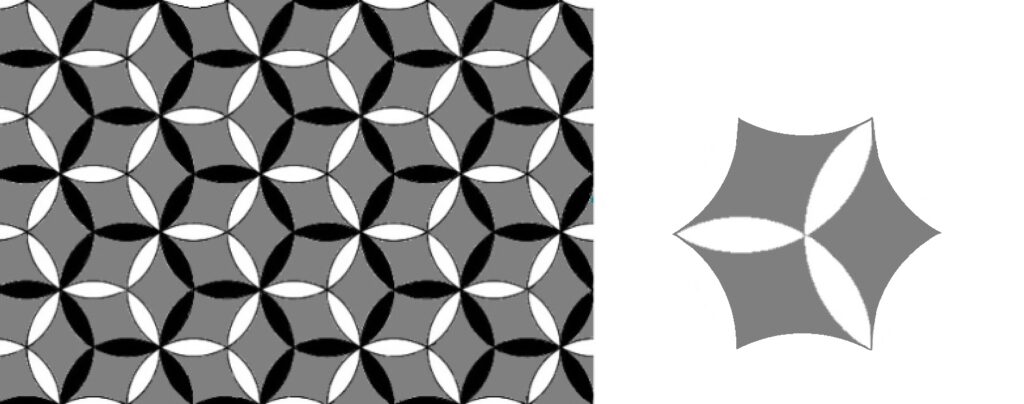
The 2D tessellation – a modified version of the rhombille tiling – (left) with the pattern inside one hexagonal cell highlighted (right)

As such, the triple inner gap colored in white will have its same shaped complementary segments on the fringes colored in black, while grey, as the intermediary shade will fill the remaining parts where the “material thinning” between full and empty happens, which in this setup is our result. Notice that in the plane both the inner and the outer curves appear concave forming an ensemble made up of three sextant (60 degree circle arcs) based tangential pseudo-astroids.

Due to the unique structure, this solid can be interpreted as one with its exterior inside and its interior outside, as all the hyperbolic surfaces are situated inward from the cross sections which separate one rhombic dodecahedral cell from another.

Parabolic coherence

Description

A tetrahedral solid composed of twelve identical minimal surfaces, formed as an interplay between a convex and a concave frame made of parabolic arcs with complementary nature. 

**********************************************************************************

The idea

It was imagined as a doubly-modified regular tetrahedron, which will both expand and contract at the same time, with the expansion happening along the edges, while the contraction according to the faces. The magnitude of the two antithetical distortions must reach the limit inside the tetrahedral frame, which in case of the convex one means even merging (fluidity), while in case of the concave one tangential joining of the constituents. 

In the beginning I falsely supposed that the two arcs will have the same curvature, moreover I hoped that a convex composition made of three neighboring arcs will smoothly overlay with a concave triad, concomitantly the minimal surfaces formed between them will match and could be evenly joined if placed accordingly. While at first this mistake was interpreted as a project failure, later I realized that there are even more interesting correlations this way. 

The simplistic, intuitive approach regarding the complementarity asks for exact coincidence regarding the opposite curvatures, however another peculiar situation happens when the two arcs correspond according to the full rotation, which may even increase, not weaken the general coherence of the structure. The certitude in this regard came when I understood that the sum of all the convex and concave arcs is 1080 degrees – thus 3 x 360 degrees –  which means a full rotation according to the three main axes together. And indeed that was the case as the distribution of the arcs is in perfect accordance with the XYZ coordinates: 2 x 180 degree curvature for each axis. Beside this I observed that the total perimeter curvature of one of the twelve minimal surfaces is 180 degrees, thus exactly “one triangle size”.

**********************************************************************************

Construction

1. The frame

As already mentioned, there will be two different arc ensembles which are intertwined according to the double tetrahedral frame. The convex cluster have to be built along the defining planes of one skeletal tetrahedron, while the concave cluster along the other (complementary) skeletal tetrahedron.

The convex part can be imagined as if a tetrahedron’s edges will bulge outwardly to such extent that the four vertices will completely disappear, while in case of the concave one the arcs have to be positioned in such manner that the vertices will change into inwardly curved arc trios. In this latter case the straight edges will split mid-length into two tangential curved halves, with the cusp points overlapping with the midpoints of the neighboring convex arcs, to which they are perpendicular in pairs (think of the crosses on a stella octangula for reference).

The convex (green) and concave (dark blue) parabolic arcs. Note: the curvature’s value is 180 degrees minus the opposite angle, hence the numbers look reversed

Regarding the concrete numerical aspects, in case of the convex part of the frame the six components have to be 109.471 degree Bézier curves, while in case of the concave cluster 70.528 degree curves divided in 35.264 degree halves. The two are complementary, summing up 180 degree along each “cross”, while the relation between their tangents (which defines their eccentricity) is 2/1 in favor of the convex half arcs.

The outer edges have the exact same curvature as the two big arcs (parabola sectors) on the surface of a classic hyperbolic paraboloid and if we invert all of them in relation to the original tetrahedron’s six edges, they will tangentially join in the very center of the solid as the earlier mentioned big curvatures of three different intersecting hypars aligned with the XYZ coordinates. On the other hand, if we invert  the four triplets formed by the inner edges according to the reference octahedron’s faces, their joints will overlap with the focus points of the hypothetical paraboloids to which the concave arcs belong. 

The double-frame made up by the convex (silver) and concave (gold) arc ensembles

There is an interesting correlation regarding the eccentricity of the arc trios as the outward bulging reaches the exact same height as the depth of the inward sagging. The cause of this coincidence is the fact that the convex half arcs with bigger curvatures (54.736 degrees) are forming the trios meeting with their rear ends, while the concave arcs with smaller curvatures (35.264 degrees) are joining in triplets with their front ends. The special nature of the parabola makes that while structurally different, both the span and the depth of the antithetical clusters will be identical at these angles, resulting that the convex and concave “vertices” will be located at the same distance from the intersections.

**********************************************************************************

2. The surface creation

The alignment of the parabolic curves compartmentalizes the skeletal structure into twelve identical “pseudo-rhombic” sectors each made up by 2 convex 54.73 degree and 2 concave 35.26 degree arcs. According to the starting vectors of the curves these arched rhombs have two 90 degree angles (between one convex and one concave component) and two 120 degree angles (between two convex, respectively two concave components), summing up 420 degree total angle. The minimal surfaces formed on these twelve frames will be the faces of the solid in question. 

The contour of one pseudo-rhombic face highlighted with teal color

These surfaces can be grouped in two types of triplets depending on which of the two tetrahedral symmetries we take into consideration. According to one of them the faces will join along the concave components and will present a more open aspect, resembling a classic parabola dish, where the convex arcs will form the rim, while the concave ones will give the depth of the structure. According to the other tetrahedral symmetry the three faces will join along the convex components and will look more restrained as in this case the rim is formed by six concave components. 

Despite the angle advantage of the convex constituents (54.74 degrees vs 35.26 degrees), the general aspect of the solid is clearly on the concave side compared to a reference octahedron with the six vertices situated at the points where 2 convex and 2 concave components are joining. Concretely, the octahedron will have significantly more volume than our solid, even if the outward bulging of the four convex arc triplets is superior to the inward sagging of the concave triplets.

Cross-section (red) showing the three-fold concavity of the solid

This counter-intuitive thing is the consequence of the fact that a closed shape is inherently convex, not neutral. Imagine that you try to close a loop formed by an alternation of convex and concave arcs of the same size. If you want to maintain the fluidity of the curve you have to use more convex than concave parts, otherwise the formed waves will go into infinity along a straight line. The same way, if our structure would be about joining the convex and concave arc triplets following a plane, than the convex ones indeed would have the “upper hand” regarding the displaced space on their side. However, in case of a closed loop with a very restricted number of parts (8 in this case) that advantage is insufficient, inclining the balance towards concavity. 

Regarding the similarity with classical polyhedrons, it shares 8 common points with the reference tetrahedron (4 vertices and 4 face centers), 6 common points with the reference octahedron (6 vertices) and 10 common points (6 quadruple and 4 triple vertices) with the reference rhombic dodecahedron. Its volume is around 2.273 times bigger than the tetrahedron, 1.76 times smaller than the octahedron (remember the “concavity dilemma”), 2.64 times smaller than the rhombic dodecahedron and 5.53 times smaller than the circumscribing sphere. One curved rhombic face has around 1.206 times smaller surface area than a reference triangular face and 1.016 times more than a plane rhombic face. The surface-to-volume ratio is bigger than all the platonic solids, including the tetrahedron to which is close. No conclusive formula have been found regarding both the solid’s surface and volume. 

The three characteristic view of the solid

The structure can also be imagined as a symbiotic bond between the planes of two tetrahedrons of different sizes, where the inscribed sphere of the bigger one is the circumscribing sphere of the smaller one. This way, the planes of the bigger tetrahedron will bend inwardly (convex), while the planes of the smaller tetrahedron will bend outwardly (concave), joining in the six vertices of a reference octahedron. The ratio between the edges of the two tetrahedrons is 3/1. The earlier mentioned “full rotations” will happen because the sum of the two antithetical curvatures is 180 degrees as both distortions are starting from the original 70.528 degree tetrahedral face angle, but while the convex ones are adding 109.471 (2 x 54.736) degrees, the concave ones are losing 70.528 (2 x 35.264) degrees.

This pattern can be taken into infinity in a fractal-like manner, where every reference tetrahedron will contain a 27 (3 x 3 x 3) times smaller one inside. This way the joints of the convex triplets belonging to one scale will overlap with the joints of the concave triplets belonging to the next (higher) scale. 

**********************************************************************************

Relatedness with 2D shapes

Based on the double correlation between the hexagon and the rhombic dodecahedron respectively the octahedron, the 2D equivalent of this solid must be a plane structure made up by an alternation of 3 convex and 3 concave 60 degree circle arcs (sextants). While in case of the 3D shape the convex and concave components aren’t identical but complementary, their distribution inside the limiting frame follows the same pattern (perpendicular, respectively tangent to the major axes). Compared to the reference hexagon, the composition made up by the six alternated sextants has the exact same surface area because the 3 convex arcs are adding the same amount what the 3 concave ones are displacing. Notice that here the joining of the antithetical curves is angled (90 degree), thus the “convex superiority” for fluidly closing the loop – as we discussed in the previous paragraph – isn’t a premise. 

Tricolor tiling with alternated sextants

While these 2D shapes can tessellate the plane according to the hexagonal partitioning, their 3D counterparts can’t form a honeycomb on their own. However, there is a specific, quasi-regular arrangement if we join together the pieces along the concave arcs. This way will appear certain “pseudo-loops” between every 8 pieces, the components of which are aligned along the edges of a cubic pattern. If we select both these cubes, respectively the original tetrahedrons before the double-distortion, the two components will have a rather interesting distribution inside the space-net, namely the 8 corners of the cubes will touch the tetrahedron’s 4 face centers. If spreading this honeycomb into infinity, the rapport between the constituent cubes and tetrahedrons will be exactly 1/2, as every cube is surrounded by 8 tetrahedrons and every tetrahedron is surrounded by 4 cubes. Note: their size differs, the constituent cubes having 2/sqrt3 times longer edges than the tetrahedrons.

Different perspectives of the space-net made up by 8 joined frames (upper row) and the related cube-tetrahedron arrangement (lower row)

And finally about the name in a nutshell: “parabolic” because the frame is exclusively made up of parabolic arcs and “coherence” because there is a deep, manifold connection between the constituents.

CNC machined anodized titanium miniature in natural context

**********************************************************************************

Honorable mentions

There are two other creations closely related to the parabolic coherence which were discovered a little earlier. The similarity is mostly given by the fact that they are sharing the same convex (outer) edges.

In case of one of them the minimal surfaces will form between pairs of three 109.471 degree parabolic arcs, without counterbalancing the structure with inner edges. This way, following the tetrahedral arrangement, there will form 4 “monkey saddle” type minimal surfaces, resembling another former solid, the elementary tetrahedral tessellator.

The three characteristic view of the two solids

In case of the second variation the inner edge triplets will be distributed again inside the tetrahedral arrangement, but they will join the convex constituents at the triple joints, not at mid-edge. As such, while the span (related to the reference tetrahedron’s edges) is identical, the concavity will be only half as deep as previously – the Bézier-curves have 19.47 instead of 35.26 degrees – being more restricted by the neighboring axes.

**********************************************************************************

Reduced tangential cohesion

Similarly to the octahedral antithesis, it was imagined last autumn during the same transatlantic flight from South America to Europe.

Description

As the name suggests, this solid is a derivation of an earlier creation named tangential cohesionWhile its frame consists of the same 24 curved edges (12 convex + 12 concave), it lacks the straight ones. Concomitantly, instead of 24, it’s made up by 12 identical minimal surfaces, each bordered by 2 convex and 2 concave arcs. 

One rhombic face highlighted with teal borders

Taking the rhombic dodecahedral skeleton out of its structure, it looses the tessellation (honeycomb) property of its predecessor. The general aspect of the solid is more delicate, “flower-like”, with both very thin and very sharp parts. The thin ones are 6 in number and are associated with the convex constituents, while the 4 needle-like spurs are formed around the concave joints. 

The three characteristic view of the tangential cohesion (upper row) and the reduced tangential cohesion (lower row)

Regarding the 12 hyperbolic “pseudo-rhombic” faces it has more similarity with the octahedral antithesis, but while there the convex and concave arc triplets are distributed in separate parcels related to the symmetry of a reference octahedron, here the arcs are fluidly intertwined, forming waves in complementary pairs. 

**********************************************************************************